

Panasonic HVX200 vs. HVX200A vs. HPX170

Panasonic HVX200 vs. HVX200A vs. HPX170

I'm in the market for a new small camcorder and have decided I'm definitely sticking with Panasonic. Nothing against the Sony Ex-1; it's a fantastic camera but many of my clients still want 24p mini DV tape so delivering Express Card data is a bit of a tough sell. That's what I always liked about the HVX200 - it really is the "swiss army knife" of digital video and is a great tool while we are transitioning between broadcast standards. Also, now that Hitachi and Fuji have jumped on board, P2 is very well supported. It has some inherent limitations but it's a very solid format and is guaranteed to be around for years. Panasonic has completely devoted its efforts to P2. The HVX200A will be the last camera with a tape drive they ever make. That's kind of amazing. It's the end of an era. However, a lot of broadcast outlets aren't even thinking about HD yet (many of Viacom's brands among them). That said, since I'm sticking with Panasonic and unfortunately have to have the legacy tape drive, I guess it's between the 200 and the 200A. I think the upcoming AG-HPX170 is a far better camera and a HUGE leap forward for mid-levels but it's not coming out until September. I've considered waiting for it and keeping my DVX for tape shoots but frankly, I can't afford to wait that long.
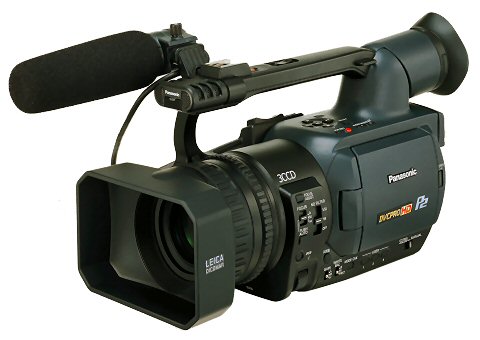
hvx200.jpg

From a cost perspective, this is how it breaks down:

New HVX200 (while they last): $5200 minus a 400 rebate = $4800 and includes a 16GB P2 card

Used HVX200: As high as $3500 on eBay and you don't get a card with that. People here in NY have been asking 3600 on Craigslist.

New HVX200A: $4995-5200 and includes a 16GB card

SO you can get a new HVX200A and it will cost 200 more than a new HVX200. A used HVX200 costs about 1300 less than a new camera but it's going to cost you about 900 for the card. 3500 + 900 = $4400 for used equipment. 4800-5200 for brand new. I'd rather pay 400 for brand new stuff that's guaranteed to never have been dropped so it looks like it doesn't really make sense to go with used gear in this case.

Factor in the HPX170: Same cost as the HVX200A (4995), includes a 16GB card, AND you're getting twice as much camera.

hpx170.jpg

Let's look at the somewhat disappointing upgrade from the 200 to the 200A. Basically it's a sensor upgrade and that's all. Of the many things they could have improved, they focused on the most important - image quality. That's good but at least an in-camera image flip would have been great.... c'mon Panasonic.

So this all new chipset has better Digital Signal Processing (DSP) resulting in:

-better low light performance: higher signal to noise ratio (i.e. cleaner images), less smear (a big problem for the 200)

-faster: 500 ASA as opposed to 200's 320 ASA

-Because chipset is a bit larger, the Leica Dicomar lens is a bit wider than the 200. The 4.2-55mm on the 200A is equivalent to 30-394mm as opposed to 32.5-423mm for the 200. Not that much wider to be honest. You're still going to be needing that wide angle converter..

That's all they gave us. Apparently they were saving all the good stuff for the HPX170! This camera is basically a wish list where everything that sucked about your 200 is fixed and every feature that you wanted was added.

Here are but a few:

-Same price as the 200A and you get a 16GB card too.

-Same chipset so you get the same great low noise, low light performance.

-Wider lens. 3.9-51mm aka 28-368. Now you're talking! That's pretty wide for a fixed lens.

-LIGHT: 4.2 lbs as opposed to the chubby HVX.

-Histogram for exposure control

-In-camera image flip for use with lens adapters

-3 kinds of focus assist

-More useful user button selections like "delete last clip"

-NTSC/PAL switchable

-The joystick from the DVX is back as opposed to the crappy 90 degree buttons on the HVX

-6 pin lockable firewire interface

-HD-SDI out (!!!!!)

-8 Scene File settings

-3 ND filers (1/8, 1/16, 1/64)

-5 year warranty like all of Panasonic's other big boy cameras.

-more of course

So, as you can see you're getting an awful lot for your 5 grand. Should I wait until September? Yeah probably.... But can't do it unfortunately.

CMOS vs. CCD - Basics

CMOS vs. CCD - Basics

The two most commonly found sensor types in both video and stills cameras are CCD (charge coupled device) and CMOS (complementary metal oxide semiconductor). Both are available in a single sensor version and more commonly for video cameras, an array of 3 sensors; Red, Green, and Blue which allows for Chroma Subsampling to compress picture information for storage and transmission. This is not an article on Chroma Subsampling, YCbCr vs. RGB, or 3 chip vs. single Bayer array. That's a whole other topic and I'll be addressing the issue at some point on this blog. The goal of this entry is merely to introduce an overview of both technologies and how they compare on a basic level.

Both basic classes of digital sensors, CMOS and CCD, accomplish the same task of capturing light and converting it into electrical signals.

CCD, Charge Coupled Device:
3CCD cameras have three separate charge-coupled devices, each one taking a separate measurement of red, green, and blue light. Light coming into the lens is split by a trichroic prism assembly, which directs the appropriate wavelength ranges of light to their respective CCDs. By taking a separate reading of red, green, and blue values for each pixel, 3CCD cameras achieve much more precision than single-CCD cameras. In a CCD, when light strikes the chip it is held as a small electrical charge in each photo sensor. The charges are converted to voltage one pixel at a time as they are read from the chip. Additional circuitry in the camera converts the voltage into digital information in the A/D or “analog to digital” conversion process. This ability to resolve colors in the A/D process is quantified in terms of Bits per color channel, 8 and 10 bit being the most common for HD video. Common production cameras using 3CCD's: Most of Panasonic's cameras, Sony F900/23, Viper, etc. CCD's also come in single chip "striped" versions. A single, striped, Super 35 sized CCD is found in both the Panavision Genesis and Sony F35. These sensors are incredibly expensive to manufacture but are arguably the highest quality with the least amount of drawbacks other than the price tag. 

CMOS, Complementary Metal–Oxide–Semiconductor:
Two important characteristics of CMOS devices are low noise immunity and low static power consumption. Significant power is only drawn when the transistors in the CMOS device are switching between on and off states. Consequently, CMOS devices do not produce as much waste heat as other types of sensors. CMOS also allows a high density of logic functions on a chip. Single chip CMOS cameras use a Bayer Mask Filter in which each square of four pixels has one filtered red, one blue, and two green (the human eye is more sensitive to green than either red or blue). This results in luminance information collected at every pixel, but the color resolution is lower than the luminance resolution. Like CCD's this color information is separated into channels and put through a chroma subsampling scheme to reduce bandwidth. In the case of RED Code RAW, the information from the chip is output as Raw Bayer data and must be “De-Bayered” (interpolated using a demosaicing algorithm) in order to be viewed. Common production cameras using single CMOS sensor: RED One, Arri D-21, Phantom, etc. 3 CMOS cameras similar to 3CCD, or 3MOS cameras are becoming increasingly common with Sony's XDCAM EX line and the Panasonic HPX300. CMOS chips tend to be more prone to non-visible infra-red (IR) light that can contaminate color saturation in video images. Though not always necessary, IR Cut filters in front of the lens is an effective way of dealing with color contamination.

CMOS vs. CCD:
Neither technology has a clear advantage in image quality. CMOS can potentially be implemented with fewer components, use less power and provide data faster than CCDs. CCD is a more mature technology and because of its "global/synchronous shutter" is far less prone to sensor artifacts than a CMOS sensor which are more commonly equipped with a "rolling shutter". This is the most immediately apparent issue between the 2 different technologies.

- Both CCD and CMOS can exhibit several of four different types of sensor artifacts: Smear, Skew, Wobble, and Partial Exposure. CCD's can suffer from vertical smearing on bright light sources, while CMOS sensors are immune to that artifact. To date, most CMOS sensors are equipped with a rolling shutter which can exhibit skew, wobble, and partial exposure. The well documented and highly undesirable problem of "Jello Cam" is caused by the way the rolling shutter scans the sensor from top to bottom. CCD's and CMOS sensors equipped with a global shutter are immune to this effect because the entire surface of the sensor is scanned simultaneously. Global shutters on CMOS sensors do exist but are extremely complicated and expensive to manufacture so are only found in more high end digital camera systems such as the high speed Weisscam HS2.

Read this in-depth and informative article on sensor artifacts by Barry Green of DVXUSER >>>

-CCD sensors, as mentioned above, create high-quality, low-noise images. CMOS sensors, traditionally, are more susceptible to noise.

-CCD's require a good deal of stable power to operate compared to higher efficacy CMOS sensors. CCDs consume as much as 100 times more power than an equivalent CMOS sensor. 

-Because each pixel on a CMOS sensor has several transistors located next to it, the light sensitivity of a CMOS chip tends to be lower. Many of the photons hitting the chip hit the transistors instead of the photodiode.

-CMOS sensors can scan and offload their footage quicker, making CMOS a more appropriate choice for high-speed cameras.

-CMOS chips can be fabricated on just about any silicon computer chip assembly line so they tend to be extremely inexpensive compared to CCD sensors.

-CMOS sensors are catching up quickly to 3CCD’s with their ability to capture a large picture on a single chip. Most Super 35 sized digital sensors are CMOS i.e., Arri D-21, RED One, etc.

-Perhaps the most hotly contested topic relating to CMOS vs. CCD is whether a Bayer array (CMOS) can match the color resolution of a 3 chip camera or striped CCD sensor. Cameras with a large, single CMOS sensor that's laden with photosites such as the Arri D-21 claim that through oversampling, true 444 RGB can be captured. Numerically speaking, the way a Bayer filter is arranged will always have twice as many green photosites as red and blue. The argument is whether or not through oversampling equal parts of RGB can be derived. One thing that isn't debatable though is that high end 3 chip cameras that are 444 capable do in fact output equal parts Red, Green, and Blue. 

Choosing a CCD or CMOS system can have a very real impact on the quality of footage your camera can shoot. While CMOS and CCD sensors do the same basic job of gathering light and turning it into a video image, they go about it in very different ways and just being aware of your camera's strengths and weaknesses is the best practical solution to the inherent limitations of the technology you're working with.

MORE TO READ:

A simple explanation of CMOS vs. CCD from Dalsa >>>

A very technical article on the topic >>>

A good article on Bayer Sensors from Cambridge in Colour >>>