Interesting Stuff - 09/18/10

Interesting Stuff - 09/18/10

With IBC wrapping and HD Expo (nee' Createasphere) and Photokina right around the corner, the web is a flurry of new product announcements and developments.

Here are a few things that have caught my eye -

Arri Alexa and Colorfront On-Set DailiesThis software is designed to solve the issue of efficiently making digital dailies that reflect the production's intentions from the Log C 444 material the Alexa generates. This is something I've been thinking a lot about lately as a DIT has to find something to do with a camera that basically shoots a digital negative. 

AJA Ki Pro Mini: I'm a huge fan of the Ki Pro but it's always had an issue - it's too damn big! That cage they made to fit the recorder in between the camera and the tripod just wasn't a practical solution. You need to be able to be mobile at a moment's notice and the Ki Pro Mini being the size of a Dionic 90 battery gets you there. ProRes 10 bit 422 HQ to compact flash cards for $2000? Sign me up. How about those aforementioned digital dailies...? Dailies that are on-line quality to boot.

Digital 35mm camcorders from Sony and Panasonic. AG-AF100 will be out by the end of the year. Sony's by early 2011. I think we'll be seeing these cameras everywhere we saw the lens adapters and everywhere we're seeing the SLR's now. Maybe even more so in the case of the SLR's because audio recording is so much more practical with an actual camcorder (no kiddin'). "Is this is the camera we've been waiting for?" We'll see. 

Sony's will be unveiled in NYC at Createsphere this Tuesday evening -

sony35.jpg

I'm assuming this is the model intended to compete with the AF-100 but I'm not certain. I won't be able to make it but I'm sure there will pics and vid of the thing floating all over the web come Wednesday morning. 

If the AF-100 is to the HVX200 what this camera will be to the EX3 than I'm already sold. The 3 with its deep paint menus and engineering essentials such as TC IN and OUT and GENLOCK is hands down the best camera in its class. Put a big chip in it and a PL mount and here's my down payment. 

RED's effect on the second hand PL lens market drove prices up enough but once these things are everywhere, I wonder how much a set of Super Speeds is going to run you... Someone is going to have to come up with a decent set of dirt cheap PL primes. As far as price goes, I'd say the RED Pro Primes aren't quite "dirt cheap" but close at least compared to a set of Cooke's or Master Primes. The problem is they're way too heavy for these small camcorders. I'm going to go out on a limb and assume that the mounts will be similar to what you find on an Sony/Panasonic ENG B4 mount camera - flimsy aluminum housed in plastic. Definitely not sturdy enough to hold those RED primes without a lot of additional support. 

Screenplane X-Y mount: This ingenious device solves the massive issue of lens tracking with zooms for stereoscopic 3D applications. Most zooms, even very nice expensive ones aren't designed with 3D in mind and they simply don't track (stay on the same X-Y axis) throughout their entire range. This means that if you want to be able to zoom or even use the lenses as variable primes when shooting 3D, you either have to have the lenses tracked at the rental house or every zoom is a re-alignment. 

Sony "EX3D"According to FDTimes, this camera has adjustable I/O (Inter-Axial Lens Distance). If you can't control the I/O, you can't control the 3D. If there was anything I gleaned from the 3D feature I recently worked on, you're usually working with a very small I/O, 1/4" or 1/2" between the 2 lenses. Granted you're not going to be able to get that kind of closeness without being in a beamsplitter as in side by side you're limited to however physically close your optics can be to each other. Good 3D is often a subtle effect and you can't be busting people's eye balls for 90 minutes straight. Realistically, in the case of the Panasonic 3D-A1, there's not a whole lot you can do with 2.5" Inter Ocular. Good for shooting bridges and buildings but not much else. With that much I/O, in order avoid creating so much parallax that you make people cross eyed, you can't be any closer than 15 or 20 feet to subject. I'll reserve judgement until I've actually had a chance to work with it but on paper there are some obvious limitations. 

3D-camera-prototype_peq.jpg

Arri Flicker Free HMI's designed for 1000+ fps use. This is a big problem for high speed videography as the MOS sensors are naturally daylight balanced and unless you have several HMI's on multiple phases, you can't really use them at frame rates higher than 120 as you'll start to see some flicker. To get the best images it's ideal to stay close to the native color temp which has been an issue in the past because of this. These 1000 Hz ballasts solve the problem. 

Italian eye wear company, Luxottica, will build passive polarization into prescription eyewear for a better 3D viewing experience. Coincidentally, Oakley (aka RED Digital Cinema) will be the US brand for the product. How interesting indeed. Building passive polarization into sunglasses may be coming next. Stereoscopic billboards anyone? 

Panasonic Mass Market 3DTV's. 50 inch screen for $2000, 42" for $1700. Still not quite cheap enough for most but the manufacturers seem to be in huge hurry to get them out there as the first consumer 3D TV's only started showing up within the last year. In another year, I predict there will be be sub $1000 models available. Then I'll buy one. 

Alexa and Chroma du Monde

Alexa and Chroma du Monde

This isn't really a presentation of test shots like I usually do for this site. I just had a quick minute during a checkout to grab a little video I've been wondering about. Being involved in the engineering side of things, one of the points I'm most curious about the Arri Alexa is its colorimetry or how it arranges the colors it sees into video color space. I had my very handy RED CDM with me, along with Leader 5330 so I took a minute and had a look at the the two primary video output modes on the camera - Rec709 and Log C. 

Rec709 is the linear, HD video output of the camera and is the fastest, easiest thing to record on-board to SxS cards if you want to start working with the footage immediately and don't have time and/or money to do a big grade. The image in this mode is beautifully crisp and colorful with fairly pleasing skin tones. Seeing as ProRes 4444 HQ can be recorded to card in real time, the 4:4:4 color space has a lot of wiggle room for correction and grading in post production. However, since the color temperature and gamma is baked in, getting a correct white balance in the field is good idea. Use a gray card.

Here's a crappy Vimeo video of the shot. I personally can't wait for a more faithful web vid compression scheme. I make the highest quality H.264 video I can in Compressor and then after Vimeo transcodes to its format, my shots always look like poop. I wish I knew a better way. 

Here are the shooting specs:

Color Space: Extended

Gamma: Rec709

Captured to internal SxS recorder @ ProRes 4444 12 bit

800 ISO

3000 kelvin color correction -3

100mm Master Prime T8

Arri Alexa - Rec709 - Chroma du Monde from Ben Cain / Negative Spaces on Vimeo.

Vector Data @ 75% Saturation, Gain x1

rec709_vector_x1.jpg

And for context - Vector Data @ 75% Saturation, Gain x2

rec709_vector_x2.jpg

As you can see, Arri has done a good job of making a faithful color gamut that looks natural and pleasing without much user interference. If you've ever looked at Sony or Panasonic colors on the scope with their skewed factory color matrix, you'll know what a big deal it is to have nice colors right out of the gate.

The color space was set to Extended as opposed to Legal and I'm wondering if that's the reason there is some unfortunate compression artifacing in the super saturated colors seen on the chart, most noticeably in blue. This is 4444 HQ 12 bit though so it should be able to handle it. I'm a little surprised to be honest. I'll have a look next time in the Legal color space as well. 

So how much can you really tell from a Chroma du Monde chart? Not that much really! You need to a diverse set of scenes with varying degrees of contrast and color temperature to see what a camera can really deliver. The Chroma du Monde does however, represent a decent amount of natural looking colors you're bound to encounter so it can give you a general idea of what you've got to work with. 

If you really want to evaluate the quality of these ProRes files and how far you can push them in post, you need to have a look at the source vid so here are clips of all the shots from this post for you to download and peruse. 

negativespaces.squarespace.com/storage/video/Alexa_qt.zip

Here's the same thing in Log C.

Color Space: Extended

Gamma: Log C

Captured to internal SxS recorder @ ProRes 4444 12 bit

800 ISO

3000 kelvin color correction -3

100mm Master Prime T8

Arri Alexa - Log C - Chroma du Monde from Ben Cain / Negative Spaces on Vimeo.

I exposed for Rec709, switched it to Log C, and left the T Stop the same. I thought it looked good on the waveform but Arri actually recommends you set middle gray to 39% for optimum exposure in this mode. By these specs, my exposure may have been a little hot for Log C believe it or not. 

logc_wfm.jpg

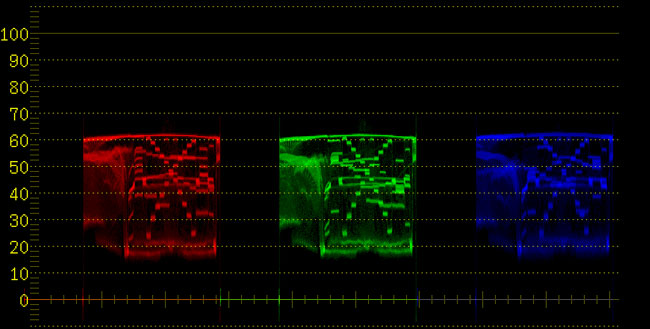
Compare the above waveform to the same for Rec709 below to get a sense of how compressed Log C is. 

rec709_wfm.jpg

Here is vector information for Log C - Saturation 75%, Gain x2:

logc_vector_x2.jpg

Log C - Saturation 75%, Gain x1:

logc_vector_x1.jpg

You can see how desaturated it is. It's also a totally different colorimetry than Rec709. The skin tone is pretty much in the same zone but Yellow, Green, and Cyan are markedly more subdued than Red, Magenta, and Blue.

As it's designed for the Digital Intermediate (DI), shooting in Log C will always buy you increased dynamic range from the camera. However it's far more work in post production as a grade/color correct will be required at some stage to linearize the image for final video delivery. Additionally, if editorial wants to start working with the Log material immediately and doesn't want to look at this flat, compressed state; the least that's required will be a display LUT applied to their monitors. 

Gary Adcock wrote this great article explaining the difference between Linear vs. Log and its origins. His explanation is far more knowledgeable and articulate so I definitely recommend giving it a read. 

The most bang for your latitude buck would be to shoot the Alexa in Log C ArriRAW, and record in T Link 444 to a data recorder like the S.Two OB-1. This will open up uncompressed, 2k Raw, 12 Bit Bayer data right off the sensor. How much of an advantage is this over shooting Log C in ProRes 4444 HQ right to card? That remains to be seen. This edit ready media is pretty powerful stuff and to be able to capture that kind of quality right in the camera is huge. 

From the Alexa Site:

http://www.arridigital.com/alexa/faq#8-2

Can the full exposure latitude of ALEXA be recorded as ProRes onto SxS cards or can the full range only be recorded using the HD-SDI or ARRIRAW outputs?

The short answer is: yes, the full exposure latitude of the ALEXA can be recorded as ProRes onto SxS cards. The long answer is this: The ALEXA sensor can capture 14 stops of exposure latitude. This image data is processed internally in a 16 bit format. Whenever this data is converted to an output, be it the 12 bit ARRIRAW, 10 bit HD-SDI, 12 bit ProRes 4444 or 10 bit ProRes 422 formats, the whole exposure range of the captured image is mapped from the 16 bit range into the respective output range (see graphic). While the range of brightest to darkest image content remains the same, the number of different lightness levels in between differ. A 10 bit image has fewer steps between the brightest and the darkest parts than a 12 bit image.

Canon 4K "Concept" Camera, etc.

Canon 4K "Concept" Camera, etc.

Even though this is a concept product, you'd never know the way they were pitching this thing at the show. If anyone thought this camera was headed for market, Canon has only itself to blame. 

It had its own booth as well as a 4K demo screening along with live announcer. Very officious. 

4k1.jpg
4k2.jpg

The 4K displays were the tastiest thing at the show. Hopefully these aren't "concept".

4k3.jpg

I think Canon really has the right idea to put the IS (Image Stabilization) inside the lens instead of the camera head or optical block. This makes their lenses far more forwards compatible and in this new era of tiny video enabled SLR's, having the IS makes a massive difference. Eventually when they get the jello shutter sorted out, it won't be as critical but for now, it's a great work through.

is1.jpg
is2.jpg

Apparently in addition to cameras, commercial printers, and medical equipment; Canon also makes superior ice skates. Who knew?

ice.jpg

And let's not forget the Canon Fashion Show. Cutting edge!

fashion.jpg

No sign of the elusive 24-70 2.8L IS or the evolution of the 5D Mk2. Photokina is right around the corner though.. C'mon Canon. Just f-n do it.