

The Side Effects of High ISO Videography
/The Side Effects of High ISO Videography
I'm often still a little shocked at just how light sensitive the Alexa really is. When I'm at my cart evaluating images shot with a fast lens at ISO 800, they are often far brighter and better defined than what you see on-set with your own eyes. When the gaffer is wishing he had 40 watt open face lights, you know you're in a brave new world. Working at such a low foot-candle becomes challenging in new ways and as I've discovered, there are a few fascinating side effects.
Red Eyes in Motion Picture - an effect that used to be very difficult to achieve on film is now far easier. For better or for worse.
When your key light source is a scant 3 foot-candles, the human eye naturally dilates considerably to accommodate such low light. When you have a source close to the lens such as a ring light and your subject's pupils are in this state, you can very easily end up with eyes that look like something like this (model on the right) -
Alexa v3 @ ISO800, Cooke S5 @ T1.4, 2.75 Foot-candles

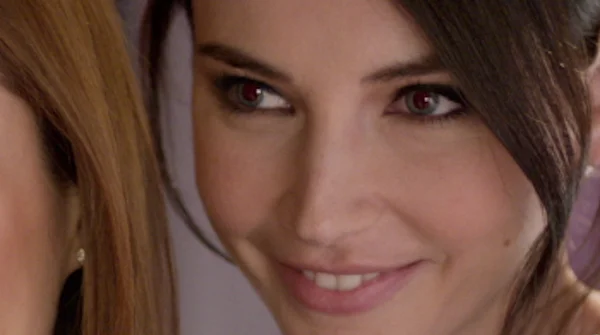
As we associate red eyes with cheap stills photography, seeing this effect in motion pictures is truly strange. The only work around is work at a higher foot-candle so the talent's eyes can adjust or to keep all your sources away from the lens.
Very interesting stuff.
Here's something else I've noticed. When you're working low light like this, the DP often wants to put ND gel on the lights themselves so to avoid dimming and color temperature shift. When you have 2 or 3 layers of this stuff on any head - tungstens especially, you will invariably need some minus green gel as well as lots of ND will usually pass more green light than red and blue. Finding the green in the scene becomes a new challenge. One more thing to keep that critical eye on the look out for.
On an Alexa related note - my fav on the fly color correction app, LinkColor, just got an update and can now import Iridas cubes from the Arri LUT Generator. I've been using Arri's basic 3D Log to 709 as my starting point as the contrast in this LUT matches what the DP is seeing on the Mon Out on the camera. This has worked out great because if he/she likes the contrast they see on their on-board monitor, you can now very easily match it on your correction with this LUT and then tweak from there. It's a great way to begin your look.


 © 2021 Bennett Cain / All Rights Reserved /